The Meaning: Power of Five
Why five fingers? Decode the profound symbolism behind the number five in the Khamsa across cultures, religions, and human experience
The Khamsa's power doesn't just come from its shape—it comes from the number five. In Arabic, "خمسة" (khamsa) literally means "five." In Hebrew, "חַמְסָה" (hamsa) also means "five." But why is this number so significant that it names one of the world's most powerful protective symbols?
The number five appears across human civilization with remarkable consistency: five fingers, five toes, five senses, five elements (in some traditions), five daily prayers (in Islam), five books of the Torah (in Judaism). It represents wholeness, balance, and human completeness.
This page explores the layered meanings embedded in the Khamsa's five fingers—from religious doctrine to sacred geometry to universal human experience.
The Five Fingers: Gateway to Meaning
👋 The Hand: Universal Human Symbol
Before we dive into religious interpretations, let's acknowledge the most fundamental meaning: the Khamsa represents the human hand.
Hands are our primary tools for interacting with the world. We greet with hands, bless with hands, create with hands, protect with hands, and harm with hands. The open palm is a universal gesture of peace ("I come unarmed") and blessing ("I give you my protection").
When we raise our hand in a "stop" gesture, we're communicating: "Halt. Come no further. I establish a boundary." The Khamsa, when positioned upward, does exactly this—it says to negative energy, jealousy, and harm: "You shall not pass."
The five fingers, then, represent our five-fold capacity to interact with reality: to sense, to act, to create, to protect, and to connect.
The Sacred Five Across Religions
Islamic Tradition
- Five Pillars of Islam
- Five daily prayers (Salat)
- Five members of Ahl al-Bayt (Prophet's family)
- Five fingers of Fatima's hand
- Five categories of Islamic law (fard, mustahabb, mubah, makruh, haram)
Jewish Tradition
- Five Books of the Torah (Pentateuch)
- Fifth letter ה (Hei), name of God
- Five fingers of Miriam's hand
- Five levels of the soul (Kabbalah)
- Five books of Psalms
Christian Associations
- Five wounds of Christ
- Five loaves in miracle of multiplication
- Hand of Mary (in some traditions)
- Five wise virgins (parable)
- Pentecost (50 days after Easter)
Universal Human Meaning
- Five human senses
- Five fingers and toes
- Five pointed star (pentagram)
- Five elements (Eastern philosophy)
- Five Olympic rings (continents)
Islamic Interpretation: The Five Pillars
In Islamic tradition, the Khamsa's five fingers most commonly represent the Five Pillars of Islam—the fundamental acts of worship that define Muslim practice:
When a Muslim wears or displays a Khamsa, each finger serves as a reminder of these spiritual obligations. The hand becomes a portable mosque, a constant reminder of one's covenant with God.
Ahl al-Bayt: The Five Holy Ones
In Shia Islam particularly, the five fingers represent the Ahl al-Bayt (People of the House):
- Prophet Muhammad (peace be upon him) – The Messenger
- Fatima Zahra – Daughter of Muhammad, the Pure One
- Ali ibn Abi Talib – Cousin and son-in-law of Muhammad, first Imam
- Hasan – Grandson of Muhammad, second Imam
- Husayn – Grandson of Muhammad, third Imam (martyr of Karbala)
This interpretation makes the Khamsa deeply personal for Shia Muslims—it's not just protection, but a connection to the Prophet's beloved family.
Jewish Interpretation: The Torah and the Name of God
In Jewish tradition, the Hamsa's five fingers are most prominently associated with the Five Books of the Torah (the Pentateuch):
By wearing a Hamsa, a Jew carries the entire Torah in symbolic form—a reminder that God's law and protection are always present.
The Letter ה (Hei)
The fifth letter of the Hebrew alphabet is ה (Hei). This letter appears twice in the Tetragrammaton—the four-letter name of God: יהוה (YHWH, often rendered as "Yahweh" or "Jehovah," though traditionally not pronounced).
Hei represents divine breath, revelation, and feminine aspects of God (the Shekhinah). Some Kabbalists associate the Hamsa with Hei, making the hand a direct invocation of God's protective presence.
The Hand of Miriam
In Jewish folklore, the Hamsa is called Yad Miriam (Hand of Miriam), honoring Miriam, sister of Moses and Aaron. Miriam was a prophetess who:
- Protected baby Moses when he was hidden in the Nile
- Led the women in song after crossing the Red Sea
- Ensured water for the Israelites in the desert (Miriam's Well)
Miriam represents protection, celebration, and sustenance—exactly the qualities the Hamsa embodies.
Kabbalistic Five Levels of the Soul
In Jewish mysticism (Kabbalah), the soul has five levels, each corresponding to a finger:
- Nefesh – The vital life force (physical)
- Ruach – The spirit (emotional)
- Neshamah – The soul proper (intellectual)
- Chayah – The living essence (transcendent)
- Yechidah – The unique point of unity with God (divine)
The Hamsa, then, represents the complete human being—from physical body to divine spark.
Universal Meaning: The Five Senses
Beyond religious doctrine, the Khamsa's five fingers correspond to the five human senses—the faculties through which we perceive reality:
Sight
- The eye sees the evil eye
- Awareness of danger
- Perception of beauty and truth
Hearing
- Listening to prayer and wisdom
- Detecting threat through sound
- Hearing the call to worship
Smell
- Sensing incense and offerings
- Detecting danger through scent
- Enjoying life's pleasures
Taste
- Discerning good from evil
- Experiencing blessing in food
- Speaking words of protection
Touch
- Physical connection to the world
- Healing through laying on of hands
- Protecting through embrace
The Khamsa, by representing the five senses, becomes a reminder to remain fully present and aware. Protection comes not just from divine intervention, but from using our God-given faculties to perceive and respond to reality.
When you wear a Khamsa, you're reminded: "Stay alert. Use your eyes to see, your ears to hear, your senses to navigate the world wisely."
Sacred Geometry: The Pentagram and Number Five
Mathematically and geometrically, the number five holds special significance:
The Pentagram (Five-Pointed Star)
The pentagram—a five-pointed star—appears in cultures worldwide as a symbol of humanity, protection, and cosmic order. Like the Khamsa, it represents:
- Human form: Head at top, arms and legs spread = five points
- Five elements: Earth, Water, Fire, Air, Spirit (or Ether)
- Venus cycle: Planet Venus traces a pentagram in the sky over 8 years
- Golden ratio: The pentagram contains multiple golden ratio proportions
The Golden Ratio (φ = 1.618...)
The number five is intimately connected to the golden ratio, found throughout nature:
- The formula for the golden ratio involves √5
- Fibonacci sequence (which approximates φ) has 5 as a key number
- Human hands have Fibonacci proportions in finger segments
This means the Khamsa's five fingers aren't arbitrary—they reflect deep mathematical harmony found in nature itself.
Five in Nature
The number five appears throughout the natural world:
- Starfish: Five-fold symmetry
- Apple core: Cut crosswise reveals a five-pointed star
- Flower petals: Many flowers have 5 petals (roses, apple blossoms, forget-me-nots)
- Human anatomy: Five fingers, five toes, five limbs with the head
The Khamsa, then, isn't just a cultural construct—it's aligned with patterns woven into the fabric of creation.
The Eye in the Palm: Watchfulness and Awareness
Most Khamsa designs feature an eye in the center of the palm. This isn't merely decorative—it carries profound symbolic weight:
The Watching Eye
The eye represents divine watchfulness and human awareness:
- God's omniscience: "The eye of God sees all"
- Counter-surveillance: The eye watches the evil eye, reflecting it back
- Consciousness: Stay awake, alert, mindful
- Protection: What is seen cannot harm you by surprise
The All-Seeing Eye Across Cultures
The concept of a protective eye appears globally:
- Eye of Horus (Ancient Egypt) – Protection, royal power, good health
- Eye of Providence (Christianity/Freemasonry) – Divine providence watching over humanity
- Third Eye (Hinduism/Buddhism) – Spiritual insight and intuition
- Nazar (Turkish/Greek) – Blue eye bead to ward off evil eye
When the eye is placed in the hand's center, it combines action (hand) with perception (eye). It says: "I see you, and I act to protect myself."
Symmetry and Balance: The Middle Finger
The Khamsa's perfect symmetry creates a sense of harmony and balance. The five fingers arrange themselves as:
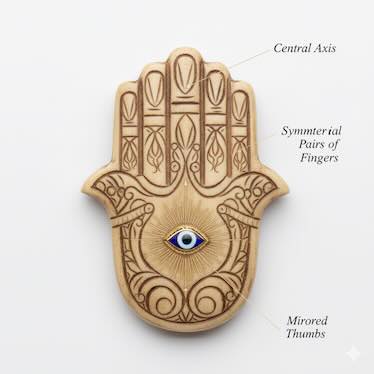
Two pairs of fingers flanking a central axis
This creates bilateral symmetry—the same pattern found in the human face, body, and most vertebrate animals. Symmetry signals:
- Health and vitality: Asymmetry often indicates disease or injury
- Beauty: Humans find symmetric faces more attractive
- Balance: Neither left nor right dominates; perfect equilibrium
- Completeness: Nothing is missing or excessive
The middle finger serves as the central axis—the fulcrum around which balance revolves. In some interpretations:
- It represents God/Spirit at the center
- The two pairs represent duality (good/evil, light/dark, male/female)
- The whole hand represents unity containing multiplicity
Modern Psychological Interpretation
Even if you don't subscribe to supernatural beliefs, the Khamsa carries psychological power:
The Placebo Effect of Protection
Psychological research shows that belief in protective symbols genuinely reduces anxiety. When you wear a Khamsa:
- Your stress response decreases (measurable cortisol reduction)
- You feel more confident in social situations
- You're less affected by others' negativity
- You have a tangible reminder of your values and identity
Whether the evil eye is "real" is less important than this fact: believing you're protected provides real psychological benefits.
Symbolic Reminder of Agency
The raised hand (Khamsa facing up) is a gesture of boundary-setting. By wearing it, you remind yourself:
- "I have the power to say no"
- "I don't have to absorb others' negativity"
- "I can protect my peace"
- "I am not helpless"
This is empowering, especially for people who struggle with boundaries or feel vulnerable to manipulation.
Cultural Identity and Belonging
For many people, the Khamsa/Hamsa is a connection to:
- Ancestral heritage (Sephardic Jewish, North African, Middle Eastern)
- Religious identity (Muslim, Jewish, or interfaith)
- Aesthetic identity (bohemian, spiritual, multicultural)
Wearing it says: "I belong to a tradition larger than myself."
The Infinite Meanings of Five
What makes the Khamsa so powerful is that its meaning is inexhaustible. Depending on who wears it and why, the five fingers can represent:
- The Five Pillars of Islam
- The Five Books of Torah
- The five senses
- The five members of the Prophet's family
- The five levels of the soul
- The five fingers that grasp and bless
- The five-fold symmetry found in nature
- The five points of the human form (head, two arms, two legs)
This multiplicity of meaning is not a weakness—it's the Khamsa's greatest strength. It allows Muslims, Jews, Christians, and secular people to find personal significance in the same symbol.
The hand remains a hand. The five fingers remain five. But what they mean—that's as infinite as human experience itself.
In the end, the Khamsa teaches us this: Five is the number of wholeness. Five is the number of humanity. Five is the number of protection. And in a broken world, we all need reminding that we are whole, human, and worthy of protection.